
Where Monroe Crime News Appears
Start with the sheriff's own site. Its press-release archive holds incident posts, including one covering work with Columbia Police, Waterloo Police, Illinois State Police, and emergency services. That tells you what the sheriff chose to announce, nothing more. It is not a same-day booking feed, so names, photos, charges, and court results may be missing.
The strongest recurring local source is the Republic-Times police-blotter archive. It spans Columbia, Waterloo, Valmeyer, and other Monroe communities. Sample entries credit police agencies, county courts, and emergency-radio dispatch. A weekly blotter is great for locating a dated report. It cannot tell you who is in custody right now, nor give a full county list.
For an example of event-driven reporting, see the sheriff's official release page.
What you see there is agency communication, not a booking-photo collection. Keep the release date handy if you cite it.
Monroe Outlets and Their Records
Every outlet works on its own schedule and scope. Official entries come first. Secondary publishers are part of the local landscape, but check anything they print against the sheriff, city police, the records office, or the court before relying on it.
| Outlet | Coverage and cadence | Photos? | Where to verify |
|---|---|---|---|
| Monroe County Sheriff press releases | Official, incident-driven announcements and multi-agency context | Not consistent; no booking feed | Sheriff release archive |
| Republic-Times | Weekly police blotter for Columbia, Waterloo, Valmeyer, and nearby communities | No routine mugshot section found; sample uses a generic news image | Police blotter |
| Belleville News-Democrat | Regional, event-driven Monroe crime reporting | May use a story-specific jail image | Local crime section |
| County Journal | Weekly PDF issues with police-blotter material when included | No routine gallery observed | County Journal |
| RiverBender | Regional event stories involving the sheriff and other agencies | May accompany a particular story | Monroe arrest example |
| Busted Newspaper | Unofficial county-local booking index with dated entries and pagination | May display booking photos | Monroe page, secondary only |
| RecentlyBooked | Unofficial county-local index; publisher claims multiple daily refreshes | Mugshot-oriented page | Monroe page, secondary only |
| Mugshots.com | Historical secondary directory with year navigation | Photo directory, not a current roster | Monroe directory, secondary only |
| Arrests.org and Mugshots.zone | No verified Monroe, Illinois local section found | No verified local image source | Do not use a guessed county path |
Some third-party pages copy fields from what they call a sheriff or clerk source. That claim is not verified as a live Monroe feed. So treat their material with care. Never lift a name, face, or charge from a secondary entry straight into a local news summary.
How Booking Photos Reach News
A booking photo reaches the news through a few doors. An agency might release it. A reporter could obtain it by public-records request. A court or jail may supply an image, or a newsroom pulls one from its own archive. Illinois FOIA Section 2.15 lists a photograph when and if available. The same statute restricts law-enforcement social-media posting of booking photos for certain lower-level offenses, with exceptions. The result: a story may run with text and no photo, or a photo may surface in only one report.
Monroe County has no verified public booking-photo feed. The sheriff's app promotes public-safety information and secure tips. Its description doesn't promise live booking photos. City police pages cover operations and records, not a photo gallery. So a newsroom may hold an image for one incident even when no public page shows that same image for every arrest.
Labels matter here. The arresting agency, the jail with the booking file, and the court may each phrase things differently. Read the source line before drawing conclusions.
What the Weekly Blotter Can Tell
Republic-Times publishes weekly or by issue, never in real time. Its blotter gives you the agency, the reported event, and the publication date. Columbia Police, Monroe County Sheriff, Waterloo Police, and neighboring departments can all appear on one page. That breadth helps you find a local report fast. Still, read the agency line first. Don't assume the county jail holds anyone mentioned.
BND and RiverBender run event-driven stories. County Journal's PDF issues add another weekly archive. Waterloo meeting materials reference a monthly activity log, and Valmeyer board minutes show police-report review. Those government records can point you toward a report you still have to request. They don't create a public booking roster or prove current custody.
The recurring local blotter archive appears here for its source and cadence.
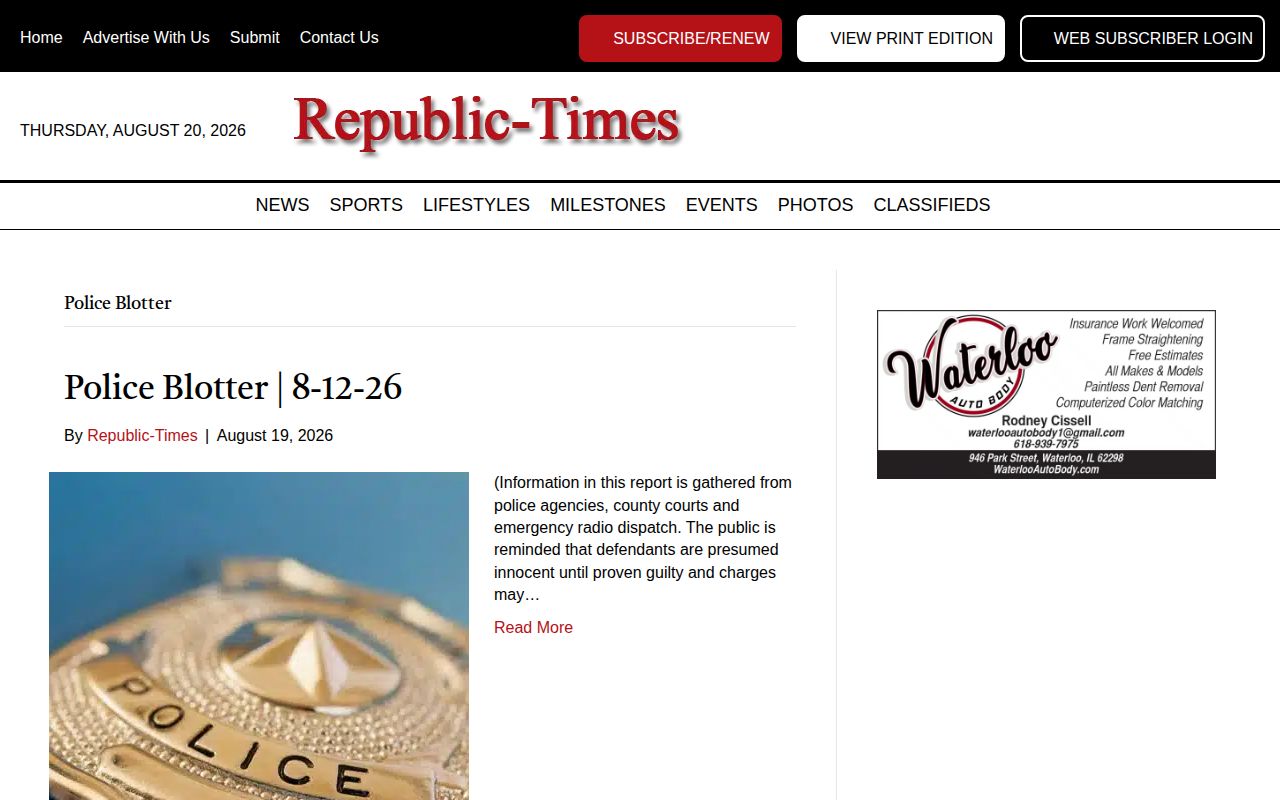
The screenshot documents a publication channel only. Don't read it as a complete list of Monroe County bookings.
Secondary Monroe Mugshot Pages
Busted Newspaper and RecentlyBooked both maintain county-labeled pages. They carry dated booking entries and photographs. Neither is official. Coverage, source claims, update patterns, and entry lifespans are all publisher decisions. Mugshots.com's Monroe directory skews historical and gallery-style. It can't stand in for a current agency response. No face archive here is reproduced, and a third-party index is never treated as a local roster.
RecentlyBooked's publisher policy offers a no-fee route for certain corrections or modifications. Busted Newspaper uses a form that asks for documentation. Those channels can help you contact a publisher about a wrong or qualifying entry. They can't erase the sheriff's record or alter a court outcome. Nor can they promise that every other copy vanishes.
The RecentlyBooked Monroe page appears only as a caveated landscape reference.
The image is contextual documentation, not an endorsement or a custody source. Official Monroe contacts and court records still come first.
From a Story to the Record
A crime story gives you leads, not answers. Pull out the agency named in it. Note the date, the jail, and the case number too. Those four details unlock the layers of the official record. Work through them in order rather than all at once.
- Save the article’s headline, publication date, agency attribution, and any case or incident detail.
- Check the arresting agency’s official page and ask whether the person entered Monroe County custody.
- Use a county FOIA or municipal police FOIA request for the booking record, arrest report, and photograph when and if available.
- Check the Monroe Circuit Clerk, Judici, or 24th Circuit path for hearings, bond, filings, and disposition.
- Compare the later court entry with the story. A charge may change, a case may be dismissed, or a person may be found not guilty.
One question at a time. Was the person arrested and booked? That answer lives in the blotter, the press release, or the mugshot caption. What happened afterward is a separate question, and the court record answers it.
Every route in one place. The Monroe County records page gathers custody checks, booking lookups, records requests, and court access for the whole county. Prefer a city source? There are police paths for Waterloo, Columbia, and Valmeyer.
Check Dates and Agencies
Monroe County sits close to the St. Louis region. Several municipal police departments work inside it. So an arrest at a Monroe address might not be a Monroe case. It could belong to a neighboring jurisdiction or land in a different jail. It might even pass to a federal or immigration authority. The sheriff, a city department, a court, and a newsroom can each hold their own piece of the paperwork.